
Scarface
1983 · Brian De Palma
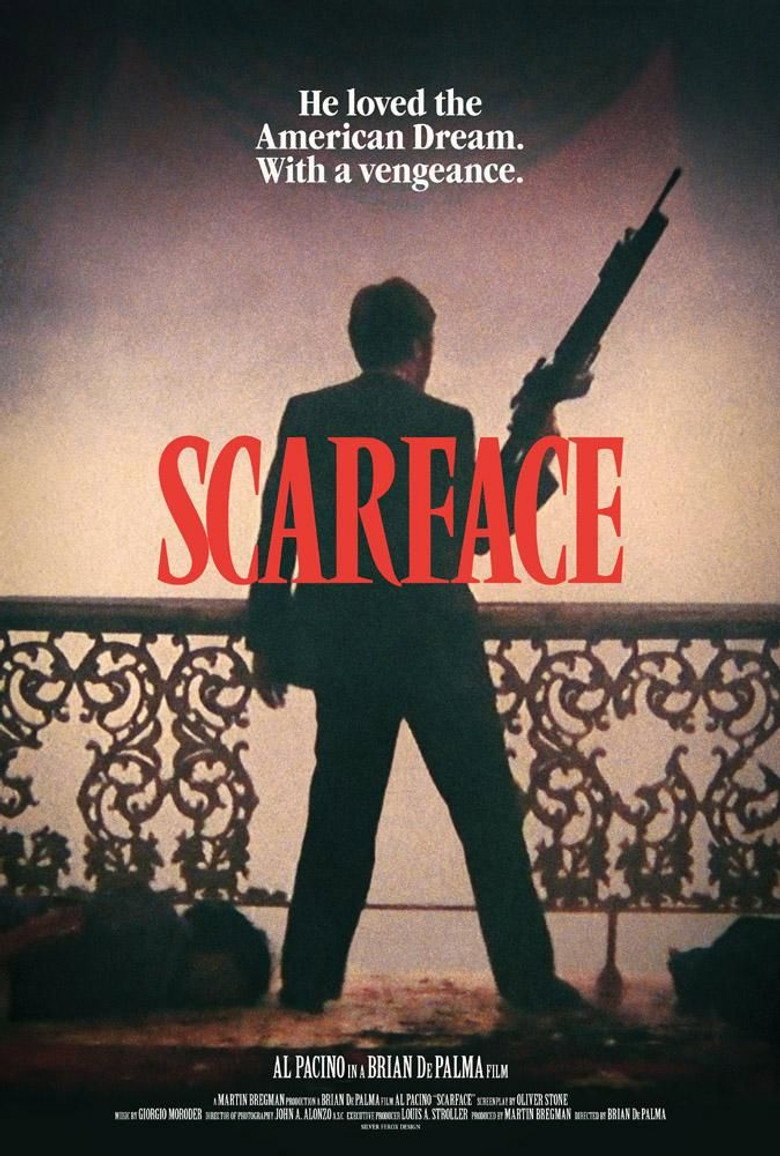
After getting a green card in exchange for assassinating a Cuban government official, Tony Montana stakes a claim on the drug trade in Miami. Viciously murdering anyone who stands in his way, Tony eventually becomes the biggest drug lord in the state, controlling nearly all the cocaine that comes through Miami. But increased pressure from the police, wars with Colombian drug cartels and his own drug-fueled paranoia serve to fuel the flames of his eventual downfall.
Spoilerhinweis — Text öffnen
“Me, I always tell the truth. Even when I lie. So say good night to the bad guy! Come on. The last time you gonna see a bad guy like this again, let me tell you.”
- Tony Montana
Scarface is one of those films where everyone remembers the violence, the cocaine, the money and Al Pacino screaming at people. But underneath all of that, there is a question that I find much more interesting: What happens when someone finally gets everything they ever wanted, only to discover that none of it actually makes them happy?
Because that is essentially Tony Montana's entire story.
When we first meet him, he is a Cuban immigrant arriving in America with almost nothing. No money, no influence, no real future waiting for him. What he does have, however, is an almost ridiculous amount of ambition. Tony wants more. He wants money, respect, power, everything that he believes will finally make him somebody.
And the thing is, he actually gets it.
He starts out as a small-time criminal, slowly works his way up through Miami's drug trade and eventually becomes one of the most powerful men in that world.
But what I find fascinating about Scarface is that Tony doesn't really become happier as any of this happens.
Quite the opposite.
The more money he makes, the more people he has to fear. The more power he gains, the less he seems capable of trusting anyone. And the closer he gets to the life he always wanted, the further away he moves from anything that could have made that life worth living.
And somehow, Al Pacino makes the entire thing absolutely incredible to watch.
His performance is ridiculous in the best possible way. Tony is loud, arrogant, impulsive and constantly trying to prove that he is the most dangerous person in whatever room he happens to enter. But especially early in the film, there is also something almost vulnerable about him.
I keep thinking about the motel scene.
Tony and his friend Angel enter what is supposed to be a relatively straightforward drug deal, only for everything to go horribly wrong. Angel is murdered with a chainsaw while Tony is restrained and forced to watch, knowing perfectly well that he could be next.
And for a moment, Tony looks genuinely terrified.
This isn't some untouchable drug lord sitting in his mansion. It's a man who has barely started climbing the criminal ladder, suddenly realizing just how disposable he is in the world he wants to conquer.
But even then, he refuses to give in.
And I think that tells us something important about him.
Because Tony doesn't simply become ruthless once he gets rich. His pride, aggression and almost self-destructive determination are already there from the beginning.
Money doesn't create those qualities.
It just gives him more and more opportunities to act on them.
And that is where the American Dream becomes such an interesting part of the film.
Tony essentially achieves its most materialistic interpretation. He arrives with nothing and ends up with everything. Expensive suits, luxury cars, an enormous mansion, a beautiful wife and more money than he could possibly need.
He becomes exactly the kind of man he once looked up to.
So why does he seem absolutely miserable?
There is something almost funny about how many songs had already explored this exact contradiction long before Scarface was released.
The Beatles had Can't Buy Me Love. Pink Floyd had Money. And The O'Jays had For the Love of Money, a song about the things people are willing to do in pursuit of wealth.
Tony Montana could have listened to all three and somehow missed the point entirely.
Because the problem isn't simply that he wants money. It's that he seems convinced money will eventually fix everything else.
But it doesn't.
His relationship with Elvira falls apart. His drug use becomes increasingly destructive. He grows paranoid, possessive and obsessed with controlling the people around him.
And then there is Manny.
That part genuinely hurts.
Manny has been with Tony since the beginning. Long before the mansion, the expensive clothes or the criminal empire, there was Manny. Someone who knew Tony when he had nothing and stayed beside him as they built their new lives.
And yet Tony ends up killing him.
Not because Manny betrayed him or because he was secretly working for an enemy, but because Tony discovers him with Gina and reacts with uncontrollable jealousy and rage.
Only afterward does he learn that Manny and Gina had secretly married.
And suddenly one of the few genuine relationships Tony ever had is gone.
Because of Tony himself.
That is the part of his downfall I find most tragic. By this point, he has accumulated so many enemies that you would almost expect one of them to be responsible for destroying his life.
But he is perfectly capable of doing that on his own.
His money doesn't protect his relationships. His power doesn't make him secure. And his obsession with controlling everything eventually destroys the very people he claims to care about.
He has everything, but he can't seem to hold on to anything.
And yet, despite all of this, the film never makes Tony quite as simple as an entirely heartless monster.
There is that moment when he refuses to go through with an assassination because it would also kill children.
Which is such a strange contradiction.
Here is a man who has murdered people, built an empire around drugs and violence, and caused an extraordinary amount of suffering. But even he has a line he refuses to cross.
Does that mean Tony is still a good person somewhere underneath everything?
I don't think so.
But I do think it makes him more interesting.
Because he clearly understands that some actions are wrong. He is capable of drawing moral boundaries. He just seems completely incapable of recognizing how often he crosses other boundaries himself.
He can condemn the cruelty of other criminals while justifying his own. He can claim to love his family while making their lives miserable. And he can insist that he always tells the truth while lying to himself about almost everything that matters.
Which brings me back to the quote at the beginning.
Tony takes pride in being the bad guy. He sees himself as more honest than the respectable people around him because, unlike them, he openly admits what he is.
But recognizing that you're a bad person doesn't somehow absolve you of the things you've done.
And maybe that is Tony's greatest contradiction.
He understands perfectly well how the world sees him.
But he never really understands himself.
Even the film's ending reflects that.
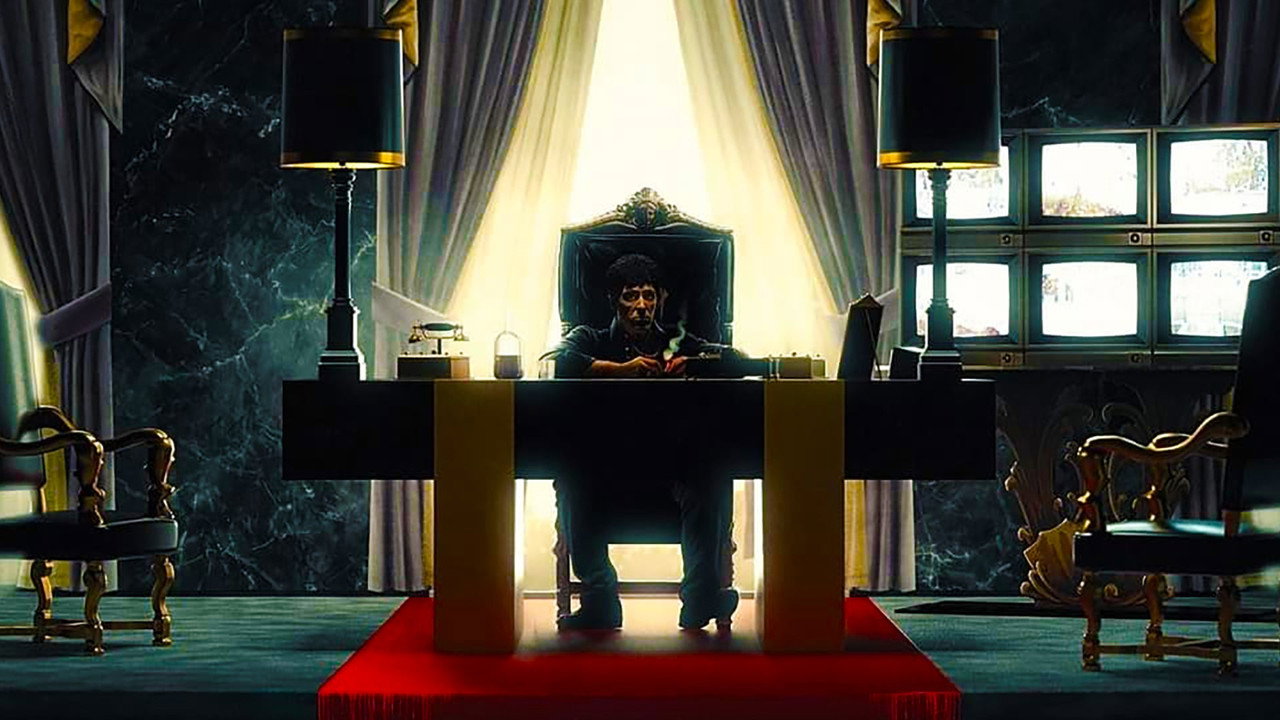
Early on, Tony is trapped in a small motel room, surrounded by criminals who want him dead. By the end, he is standing in an enormous mansion, surrounded by unimaginable wealth, once again facing men who have come to kill him.
The difference is that this time there is no Manny coming to save him.
And I love how cruel that parallel is.
Tony spends the entire film climbing toward a life in which he believes nobody will ever be able to threaten him again.
Only to end up in almost exactly the same situation he started in.
Just with a bigger house.
Scarface is excessive, violent, sometimes almost absurdly dramatic, and Al Pacino's performance is completely unforgettable. But underneath all of that spectacle, I think there is something surprisingly sad about it.
Tony spends his entire life chasing a dream without ever really questioning what that dream is supposed to give him.
He wants money because he thinks it means freedom. He wants power because he thinks it means security. He wants everything because he believes that eventually, if he just has enough, he will finally be satisfied.
But there is always something more to take. Something else to prove. Someone else to fear.
And maybe that is the real tragedy of Tony Montana.
He doesn't fail to achieve the American Dream.
He achieves it, and it still isn't enough.
The world was his.
He just never figured out what to do with it.
Filmdaten und gegebenenfalls Bildmaterial: TMDB.